


2026 Suffrage Science Awards - Life Sciences
Updated: Apr 30
The Ceremony of the Suffrage Science Awards in Life Sciences took place on 9 March 2026, at the Department of Biochemistry and the Sir William Dunn School of Pathology, two institutes at the heart of the University Science Area in Oxford.
For highlights and reels of the evening, visit our Instagram account.
Prof Chrystalina Antoniades - nominated by Lynn Rochester

Professor Antoniades is leading work transforming the way people with neurodegenerative brain conditions (such as Parkinson’s) are diagnosed and monitored. Using the latest digital technology to measure movement (eyes, hands, and body) coupled with advanced artificial intelligence, she aims to identify people with these conditions as early as possible and accurately monitor their progress.
Her contributions are helping to fundamentally change how new therapies are evaluated and inform personalised treatments, ultimately improving the lives of people worldwide. Her scientific discovery and support of early career researchers is balanced against her talent and passion to engage the public and patients with these conditions about her work—building trust in science. She is truly deserving of this award.
Dr Sarah Cooley - nominated by Samantha Joye

Dr Sarah Cooley is an acclaimed marine and climate scientist, specialising in the ocean carbon cycle. In addition to her research and mentoring of young scientists, she has contributed significantly to intergovernmental panels on climate change and has worked for many years across multiple institutions in science outreach, policy, and advocacy.
Sarah was Director of Climate Science at the Ocean Conservancy for over a decade and, until recently, was Director of the National Oceanic and Atmospheric Administration’s (NOAA) Ocean Acidification Program of the United States government. Sarah is now Executive Director of the non-profit Earth Science Data Professionals organisation, where her commitment to interdisciplinary science, innovation, communication, and fundraising is truly inspirational.
Dr Cara Croft - nominated by Selina Wray

Dr Croft is an emerging leader whose cutting-edge research in Alzheimer’s and Parkinson’s disease is shaping the future of neurodegeneration research.
She exemplifies the leadership, integrity, and inclusivity our field urgently needs, while proudly championing women in neuroscience. Cara is also a dedicated and generous mentor, providing outstanding support to early-career researchers.
Dr Camille Dion - nominated by Frederique Magdinier

Dr Dion is a Transition to Independence Fellow at the MRC LMS in London. Her research focuses on elucidating the mechanisms underlying male infertility, with the goal of advancing our understanding of early human germline development. Her work also aims to define the regulation of LINE elements in the male germline.
I have known Camille for many years and can attest that she is an exceptionally efficient and proactive researcher, as well as a deeply thoughtful and principled individual. I selected her for this award because, at an early stage of her career, she demonstrated remarkable courage by raising her voice, much like the Suffragettes of the past, to demand respect. In doing so, she took personal risks to support her peers. Despite these challenges, she remained strongly committed to her work. In addition, she is deeply involved in the training of younger scientists and the transmission of knowledge, while developing innovative projects with direct applications in human health.
Dr Dima A. Hammoud - nominated by Monica Shokeen
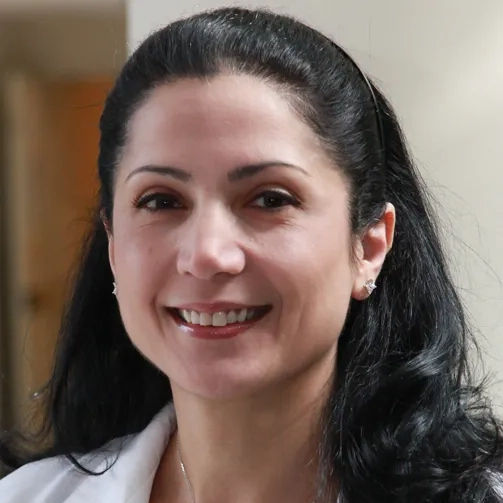
Dr Dima Hammoud is a senior investigator and neuroradiologist at the National Institutes of Health. Her research centers on addressing critical questions surrounding emerging health threats—namely infectious diseases—to improve understanding of those diseases. Her laboratory leverages molecular imaging to develop, validate, and advance novel diagnostic tracers for fungal infections, with the goal of translating these innovations into clinical applications that improve human health.
Dr Hammoud is highly accomplished in both research and clinical care. She is known for her resilience, honesty, compassion, and humility. Born and raised in Lebanon, Dr. Hammoud understands the impact that voices and opinions can have on shaping society. She is an exceptional role model for trainees of all nationalities and backgrounds. Her accessibility, mentorship, and inclusive leadership style make her truly deserving of a Suffrage Science Award.
Prof Karoline Kuchenbaecker - nominated by Martha Shahbazi

Karoline Kuchenbaecker is an exceptional genetic epidemiologist whose research has transformed how we understand the genetic and environmental drivers of complex disease. I am deeply inspired by her commitment to making genomics more inclusive through pioneering work in diverse and historically under-represented populations to help reduce global health inequalities.
Alongside her academic leadership, she plays a key role at Genomics England, helping shape programmes that ensure genomic medicine benefits all communities. Beyond her scientific excellence, Karoline is a deeply caring mother and a thoughtful global citizen, committed to tackling inequality and wider global challenges.
Dr Madeline Lancaster – nominated by Prisca Liberali

Madeline Lancaster is a pioneering developmental neurobiologist whose breakthrough work established cerebral (brain) organoids as a transformative model for human brain development and disease, beginning with her landmark demonstration that stem-cell derived cerebral organoids can model human neurodevelopment and microcephaly. Beyond founding and continually advancing the brain organoid field, her lab has driven cutting-edge, comparative approaches: using organoids to probe what is uniquely human in brain development and to illuminate mechanisms underlying evolutionary expansion of the human forebrain.
Her work also exemplifies the rigor needed to address biologically meaningful differences, including incorporating male and female stem-cell lines and frameworks for studying sex-linked variables in organoid systems. Equally important, Madeline is widely recognized as an exceptional leader and role model bringing remarkable energy, clarity of vision, and generosity to the community. She is an outstanding mentor who empowers trainees to be bold, creative, and rigorous, and her influence is evident not only in her scientific contributions but in the people she develops.
Dr Liset Menendez De La Prida - nominated by Azahara Oliva

I am writing to enthusiastically nominate Dr. Liset Menéndez de La Prida, full research professor, leader of the Laboratory of Neural Circuits at the Cajal Institute (Madrid) and Director of the new Cajal Neuroscience Center of Spain’s national research center (CSIC), for the Suffrage Science Award. After training as a physicist, Liset became an internationally recognized leader in Neuroscience, holding positions in Scientific Advisory Boards and Evaluation Committees of several institutions.
Her multidisciplinary work, including nearly a hundred publications in top journals in the field and a recent book (“Cerebro, espacio y tiempo”), has significantly contributed to the understanding of the brain’s mechanisms of navigation during health and disease. More importantly, Liset has built this thriving and impactful career from the ground up, with a level of passion and determination for science that, to date, keeps inspiring many beyond her laboratory and across the globe. She is a force of nature that has been able to redefine what is possible in neuroscience and in society, serving as a powerful testament about the impact of excellence in science. Liset has set up an example that has opened doors and continues to inspire countless women in science, proving that passion and talent can shape the world to be better because she dared to lead.
Prof Arwen Pearson – nominated by Areej Abuhammad

Areej Abuhamma nominated Arwen Pearson for her pioneering structural biophysics and transformative commitment to empowering women scientists. Through key leadership roles, she has revolutionised time-resolved crystallography, creating molecular movies of biomolecules that advance structural biology and address critical health challenges including COVID-19.
Arwen embodies the Suffrage Science spirit through exceptional mentorship: as a Humboldt Scout and training school leader, she opens world-class science to early-career women while modelling leadership that is rigorous, humane and empowering. She is not only an outstanding scientist and mentor but also deeply compassionate and generous with her support. Her unwavering encouragement has empowered me to claim my voice and has transformed my career. She lifts others as she leads, embodying the Suffrage Science vision of an heirloom passed from one woman leader to another, and it is my privilege to see this jewel come to rest in her hands.
Prof Kate Watkins – nominated by Faraneh Vargha-Khadem

It is my great pleasure to nominate Professor Kate Watkins as a recipient of the 2026 Suffrage Science Awards. Kate is a leading cognitive neuroscientist whose research has transformed our understanding of the neural basis of speech and language. Starting from her PhD project, Kate has carried out ground-breaking research in developmental speech and language disorders, including verbal and oral-motor dyspraxia associated with a mutation in the FOXP2 gene, and developmental stuttering.
She leads the Brain, Speech and Language Research Group at the University of Oxford where she has combined state of the art neuroimaging techniques with non-invasive brain stimulation to deliver mechanistic insights with clear translational implications. Her influential studies include demonstrating improved fluency in adults who stutter using transcranial direct current stimulation alongside speech-fluency training. She has also provided exceptional academic leadership and service to the field by co-founding the Society for the Neurobiology of Language, and serving as Co-editor-in-Chief of the Society’s journal Neurobiology of Language.
Dr Dana Pe'er - nominated by Suffrage Science, in memory of Prof Zena Werb

Dana Pe’er is known for her foundational work in computational/systems biology and her high-impact mentorship and advocacy for women in science, especially in quantitative fields. She is Chair and Professor in the Computational and Systems Biology Program at the Sloan Kettering Institute, where she helped build one of the most influential computational biology programs in the world, and has been a Howard Hughes Medical Institute (HHMI) Investigator since 2021.
Pe’er’s research focuses on understanding the organization, function and evolution of molecular networks, particularly how genetic variations alter the regulatory network and how these genetic variations can cause cancer. Her early work in single-cell network inference is often cited as foundational for today’s explosion in single-cell genomics.


Comments